
 EN
EN
 FR
FR
 DE
DE
 ES
ES
A Pacifist School on the Front Line
Interview by Anne Marie Borsboom ShareDoc Founder & Filmmaker
House of Hope is an intimate, observational film about Manar, a Palestinian woman who runs a pacifist Waldorf school in the occupied West Bank with her husband Milad. Amid escalating violence, stress, and uncertainty, they strive to provide a safe haven for young children.
How did you get started with House of Hope?
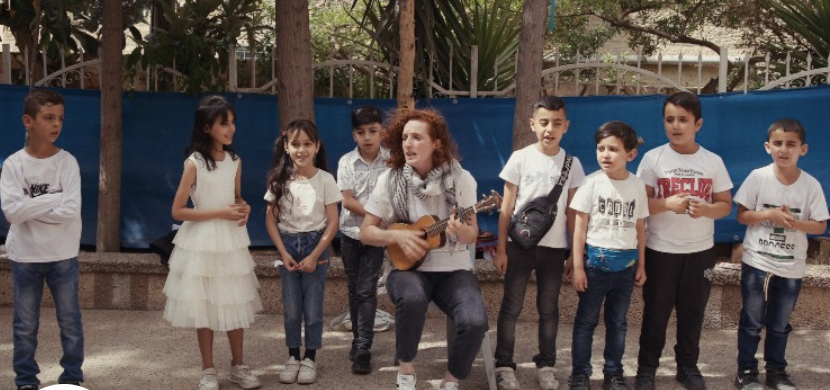
Marjolein: Eighteen years ago, I was in Palestine as a photographer. That’s where I met Manar. I was impressed by her idealism. She spoke passionately about her dream of creating a better future for Palestinian children, and her vision of establishing a unique school. We kept in touch over the years. One day she told me she had succeeded: she had founded her school. That’s when I knew I had to follow her on this mission.
Manar doesn’t care much for rules. She goes her own way. Her dream has always been to advocate for Palestinians and help change how people see them. When I met her, she said, ‘They have a completely wrong image of us.’
During the three years of production, I wanted to help Manar, but as a director I cannot and should not pay my protagonists. At the same time, the audience has a direct way to support them, and I think the ShareDoc page for House of Hope is a real solution for us. Once you’ve made a film and sent it out into the world, it’s powerful to be able to offer the audience a tool like this to donate. It’s especially effective when the school receives funds and can decide how to implement them in their program.
We’re very happy with the ShareDoc platform. I say ‘we’ because the whole team of 100% FILM Is enthusiastic about it. We even got a little addicted to checking whether there were new donations. We’re hooked on ShareDoc because it’s wonderful to have a tool that shows what’s happening live, and how the audience is engaging. We noticed that our audience really loves to help after watching the film. The platform is a super concrete solution.
And I also like that we’re not doing this as a production company ourselves, but that everything is organized through the ShareDoc platform. ShareDoc is independent, which creates a bit of distance, and that’s important for a documentary.”
Your film collected a lot in a very short time at IDFA in November last year. Were you surprised?
Marjolein: Some people donate so much that I was very surprised, like 500€. That’s really bizarre. But I was also happy with a 5€ donation. I saw a family of four, the father and the mother, and the son and the daughter. Their phones went up to scan the QR code. That was so heartwarming to see. Our film had a concrete help question: the school. And that helps, because the audience knew quite clearly what their donation could do.
Before the premiere, we had an interview with a Dutch newspaper, The Volkskrant. And they named ShareDoc in the article, with no QR code or link to the website. Even so, it already took off, with donations up to 1000€. That’s where it started. And we had a photo exhibition connected with the film. So my advice to other filmmakers is: name your campaign on ShareDoc if you have a publication.
What was your experience running a campaign on ShareDoc?
Marjolein: The website is very well organised. It’s nice that everyone involved has a place, from protagonist to producer/co-producer, director, etc. It’s powerful. Yes, it takes some time, but it’s worthwhile to edit it well. It becomes a platform for the whole film, and it’s not static. You can keep it updated with new screenings to come. The QR code works best in the credits, but we also printed flyers for older people who had problems scanning the QR code. As a filmmaker, we now give our audience a chance to unleash their feelings. And with the ShareDoc platform, it doesn’t feel uncomfortable. It’s so wonderful.
We could have arranged a campaign via our House of Hope website, but we didn’t choose that option because of the benefit of an organisation in between. It makes it more transparent. ShareDoc is independent, it’s not connected with our production company, and yes, there is a small fee, but that’s worthwhile.
I had seen a film in the cinema with the ShareDoc QR code and was sold on the idea of being able to create a campaign page on the platform. So now I’m telling all my colleagues who are working on impact documentaries about ShareDoc.
We are very happy with the outcome of the campaign already, and we are just beginning. After the first screening in November 2025, it was 4000€. Now we are over 13K.
What’s the next step for the film?
Marjolein: We are awaiting invitations from festivals and the film will be broadcasted in the Netherland by Broadcaster Black NPO3 (Omroep Zwart) in April with the QR code included.