ShareDoc
Desafortunadamente, esta página no está disponible en español. Pedimos disculpas por las molestias.
26$ = 1 DELIVERY KIT = TWO LIVES SAVED!
Unfortunately we cannot load this video because of your cookie preferences. Please allow functional cookies if you want to view this video.
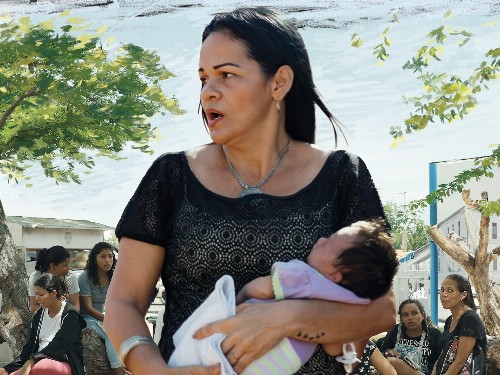
Visit the Cookie Policy pageTHE CORD follows Carolina, a community health worker in Maracaibo, Venezuela, where a collapsed healthcare system leaves families to source their own medical supplies. One basic delivery kit costs about $26, roughly seven months of the minimum wage. After Maduro's removal, help from the US has been announced: 25 pallets of medical supplies by February, more than $386 million for earthquake relief by July. So why are the families Carolina works with still struggling to buy their own supplies?
One delivery kit inlcudes:
Laparotomy kit, patient and surgeon gowns, shoe covers, surgical caps for women and men, face masks, sterile gloves, and a macro drip IV set, along with an IV catheter (Yelco) size 18. It also lists syringes in 3, 5, 10 and 20 cc sizes, a Foley catheter size 16, a urine collection bag, 0.9% saline solution, a suction catheter, 18x18 abdominal gauze pads, sterile gauze, sterile soap, alcohol, hydrogen peroxide, size 23 scalpel blades, a cautery pencil, adhesive tape, a size 27 spinal needle, an umbilical cord clamp, and an ampule of vitamin K. For closing, it calls for Vicryl suture size 1, chromic suture in sizes 1 and 0, silk suture size 1, and nylon suture size 2/0, plus electrodes, an ID wristband, and white sheets. The medication section covers atropine, ephedrine, neostigmine, bupivacaine 0.5%, lidocaine 2%, midazolam, propofol, Ringer's solution, an antibiotic, an analgesic, a blood transfusion set, 5% glucose solution, oxytocin, and 500 mg of hydrocortisone
----
Carolina and her community dream of building Maracaibo's first community-led birthing center that weaves together ancestral and traditional medicine with the safety of modern accompaniment.
This dream is born from a healthcare system in profound collapse, one meticulously documented by Venezuela's own National Hospital Survey (ENH). For over five years, a network of resident doctors has monitored the country's 40 largest hospitals. Their 2024 Mid Year Report reveals a stark reality.
In the first half of 2024, the average shortage of basic emergency supplies across these hospitals was 36%, a figure that has not improved in years. In the operating rooms, where many births become surgeries, the shortage soars to 74%.
The ENH found that in 91% of monitored hospitals, patients, mothers included, are asked to provide their own supplies just to be admitted to the operating room, regardless of whether the surgery is an emergency. For a woman needing a C-section, her family must first find and pay for items like sutures, painkillers, and even sterile gowns. By July 2024, the cost of this basic surgical kit averaged $103 USD. To put this in perspective, Venezuela's minimum wage at the time was approximately $3.5 per month, meaning a family would need nearly 29 months of minimum wage income to afford the supplies for a single, life-saving surgery.
The consequences are measured in time and lives. The "door-to-needle time": a critical window for saving a life, is stretched far beyond safe limits. A patient having a heart attack waits an average of 74 minutes for the first medication, far exceeding the international standard of 30-45 minutes. One can only imagine the delays a woman suffering a postpartum hemorrhage or an obstetric emergency faces in this same system.
Behind these numbers is a deeper loss. The ENH notes that the shortage is not a temporary blip but a "failure at the level of authorities and decision-makers".
 ES
ES
 EN
EN
 FR
FR
 DE
DE